

The Mariwai Project x LifeShip “Pyramid on the Moon.”
Moon Launch Imminent
Ben Handelman, founder of LifeShip invited Shiva Lynn Burgos to the MOON! to curate a collection of her artworks produced in the 3rd largest rainforest on earth to compliment his pyramid, a record of earth in its diversity of arts, ideas and biodiversity. Portraits of the original inhabitants and her clan family, alongside 360VR leading edge technology filmmaking and more depict the ancestral ceremonies of remote East Sepik Province, Papua New Guinea. As well, Shiva invited her Shin-Do co-founder, Skinder Hundal to participate in Shannon Mullen O’Keefe’s Museum of Ideas, also on board for its future millenia on the lunar surface.
This historic mission successfully launched with LifeShip on the SpaceX Falcon 9, Firefly Aerospace Blue Ghost mission Wednesday, 15 january 1:11 AM EST Florida time, 16:11 in PNG. The mission includes several key stages: orbital flight, propulsion to the moon, moon orbit (approximately 16 days), and the anticipated landing on Mare Crisium crater, Moon, roughly five weeks after launch on March 2.
Why It Matters
This moon mission is not just a feat of technology but a testament to humanity’s imagination and creativity. It preserves and elevates the stories of Earth—its biodiversity, arts, and ideas—for future generations, while spotlighting the ancestral heritage of Papua New Guinea.
Featured PNG Artworks
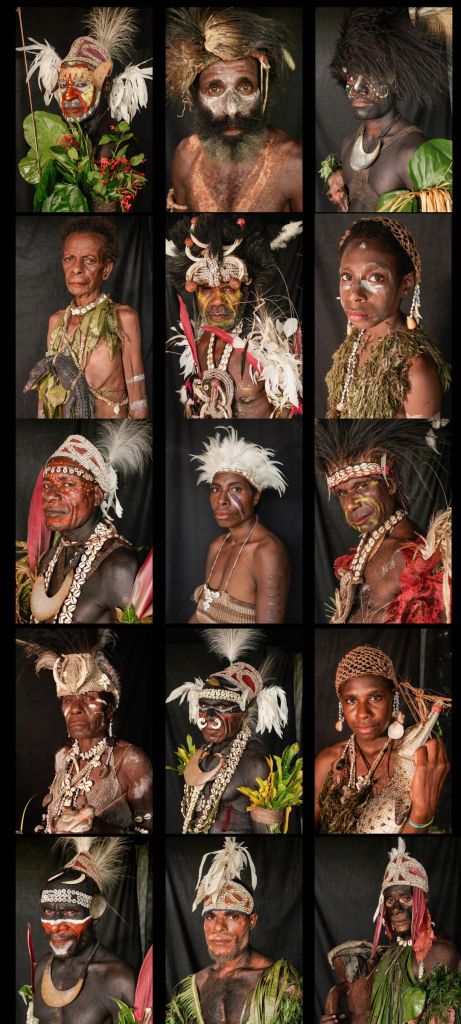
Sepik River Portraits Project
In August 2018 Burgos set up a field photo studio to capture portraits of 100 individuals from the Sepik River community. In addition to the images she recorded each individual’s name, tribe and village affiliation. The format, pose and lighting reference classic formal Flemish portaiture.

Inside Tokimba (Short)
Inside Tokimba is an immersive experience that takes the viewer into the heart of both the public and secret spectacular initiation ceremonies for the inauguration and naming of a new spirit house along the Sepik River named Tokimba. Directed by artist Shiva Lynn Burgos and invited filmmaker Nick Hunter of Paper Moose this 360-degree Virtual Reality film is the result of The Mariwai Project, Burgos’ long-term artistic and cultural collaboration with the Kwoma people of Mariwai Village, Papua New Guinea, which enabled the privileged access to these rare and extraordinary events.
Watch here: https://www.youtube.com/watch?v=GwQtyOH3Aws
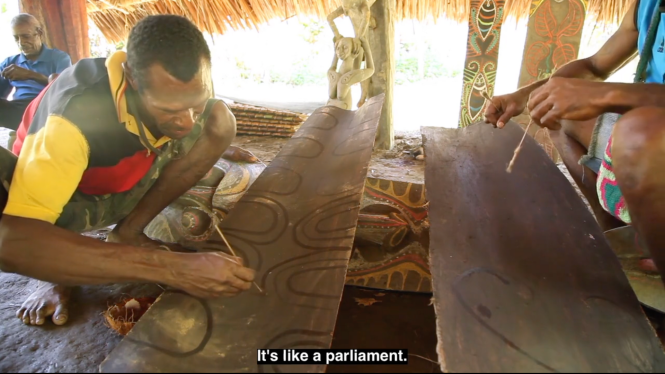
Tokimba Spirit House
Shiva Lynn Burgos was commissioned by the Ethnologisches Museum in the new Humboldt Forum at the Berlin Palace. The permanent collection features her photographic work and the new film Tokimba Spirit House which introduces The Mariwai Project, her intimate involvement with the carvers and painters of Papua New Guinea.
Watch here: https://vimeo.com/922008508
The Moon Capsule Interviews: A Curated Collection of Ideas
The Moon Exhibition No. 1 is a raw exploration into the most basic question about ideas: What is an idea? The interviews featured in the exhibition offer a glimpse into the minds of today’s thinkers, creators, and visionaries. The project aims to immortalize these ideas on the Moon, ensuring their preservation for generations to come. The ideas explored in this exhibition aren’t just theoretical; they’re sparks of insight and innovation that represent the transformative power of human thought.
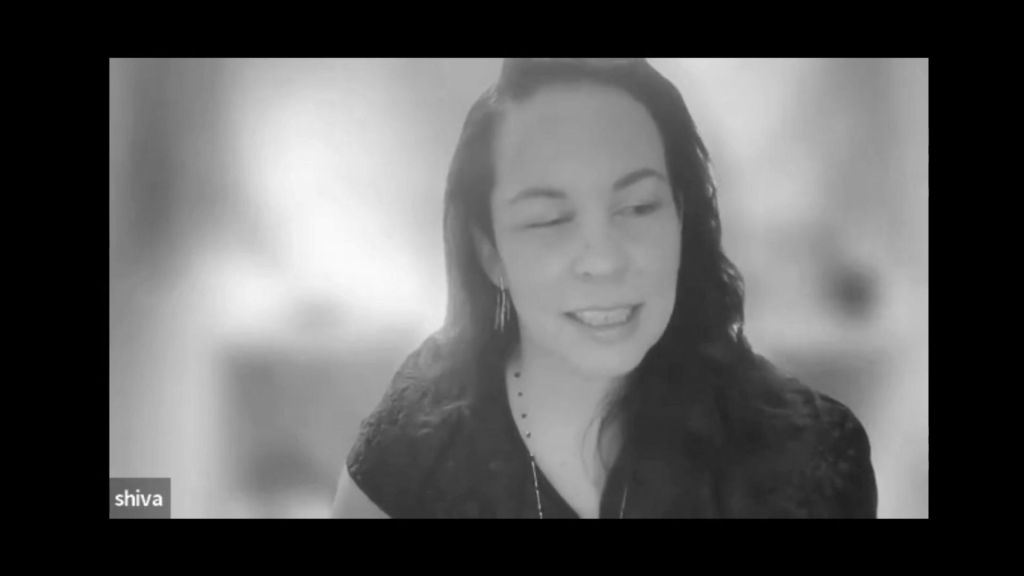
Shiva Lynn Burgos on the Role of Recognition in the Formation of Ideas
For Shiva Lynn Burgos, an idea is fundamentally about recognition. It is about understanding one’s sense of self and how that self relates to the outside world. For Shiva, an idea is born from the process of self-discovery and the dynamic relationship between the individual and the surrounding environment. Ideas arise through the recognition of one’s role in the broader tapestry of life, sparking deeper understanding and thought about our place in the world. In her interview, Shiva elaborates on how this recognition manifests in the creative process, allowing individuals to engage with and reinterpret their surroundings. For her, ideas aren’t just abstract thoughts; they are an extension of the self—a conversation between the inner world and the outer world.

Skinder Hundal on the Nonlinear Nature of Ideas
For Skinder Hundal, ideas transcend the linear and pragmatic. He believes ideas emerge not from structured thought processes but from the interplay of creativity and imagination. Ideas are spontaneous and free-flowing, unable to be confined within a fixed framework. To Skinder, ideas are expressions of pure thought that often defy conventional boundaries, transcending logic and expectation. In his interview, Skinder emphasizes the importance of imagination in the formation of ideas. He suggests that they arise in moments of inspiration, without calculation, and can lead to new pathways of thinking and doing. Ideas, when allowed to flourish, possess the power to disrupt the status quo and create something entirely new.
2 Private Lunar Landers Head toward the Moon in a Roundabout Journey
CAPE CANAVERAL, Fla. (AP) — In a two-for-one moonshot, SpaceX launched a pair of lunar landers Wednesday for U.S. and Japanese companies looking to jumpstart business on Earth’s dusty sidekick. The two landers rocketed away in the middle of the night from NASA’s Kennedy Space Center, the latest in a stream of private spacecraft aiming for the moon. They shared the ride to save money but parted company an hour into the flight exactly as planned, taking separate roundabout routes for the monthslong journey. It’s take 2 for the Tokyo-based ispace, whose first lander crashed into the moon two years ago. This time, it has a rover on board with a scoop to gather up lunar dirt for study and plans to test potential food and water sources for future explorers. Lunar newcomer Texas-based Firefly Aerospace is flying 10 experiments for NASA, including a vacuum to gather dirt, a drill to measure the temperature below the surface and a device that could be used by future moonwalkers to keep the sharp, abrasive particles off their spacesuits and equipment. Firefly’s Blue Ghost — named after a species of U.S. Southeastern fireflies — should reach the moon first. The 6-foot-6-inches-tall (2-meter-tall) lander will attempt a touchdown in early March at Mare Crisium, a volcanic plain in the northern latitudes. The slightly bigger ispace lander named Resilience will take four to five months to get there, targeting a touchdown in late May or early June at Mare Frigoris, even farther north on the moon’s near side.
“We don’t think this is a race. Some people say ‘race to the moon,’ but it’s not about the speed,” ispace’s chief financial officer Jumpei Nozaki said this week from Cape Canaveral.
Both Nozaki and Firefly CEO Jason Kim acknowledge the challenges still ahead, given the wreckage littering the lunar landscape.
Only five countries have successfully placed spacecraft on the moon since the 1960s: the former Soviet Union, the U.S., China, India and Japan. We’ve done everything we can on the design and the engineering,” Kim said. Even so, he pinned an Irish shamrock to his jacket lapel Tuesday night for good luck. The U.S. remains the only one to have landed astronauts. NASA’s Artemis program, the successor to Apollo, aims to get astronauts back on the moon by the end of the decade. Before that can happen, “we’re sending a lot of science and a lot of technology ahead of time to prepare for that,” NASA’s science mission chief Nicky Fox said on the eve of launch. If acing their respective touchdowns, both spacecraft will spend two weeks operating in constant daylight, shutting down once darkness hits. “Once lowered onto the lunar surface, ispace’s 11-pound (5-kilogram) rover will stay near the lander, traveling up to hundreds of yards (meters) in circles at a speed of less than one inch (a couple centimeters) per second. The rover has its own special delivery to drop off on the lunar dust: a toy-size red house designed by a Swedish artist. NASA is paying $101 million to Firefly for the mission and another $44 million for the experiments. Nozaki declined to divulge the cost of ispace’s rebooted mission with six experiments, saying it’s less than the first mission that topped $100 million. Coming up by the end of February is the second moonshot for NASA by Houston-based Intuitive Machines. Last year, the company achieved the first U.S. lunar touchdown in more than a half-century, landing sideways near the south pole but still managing to operate.
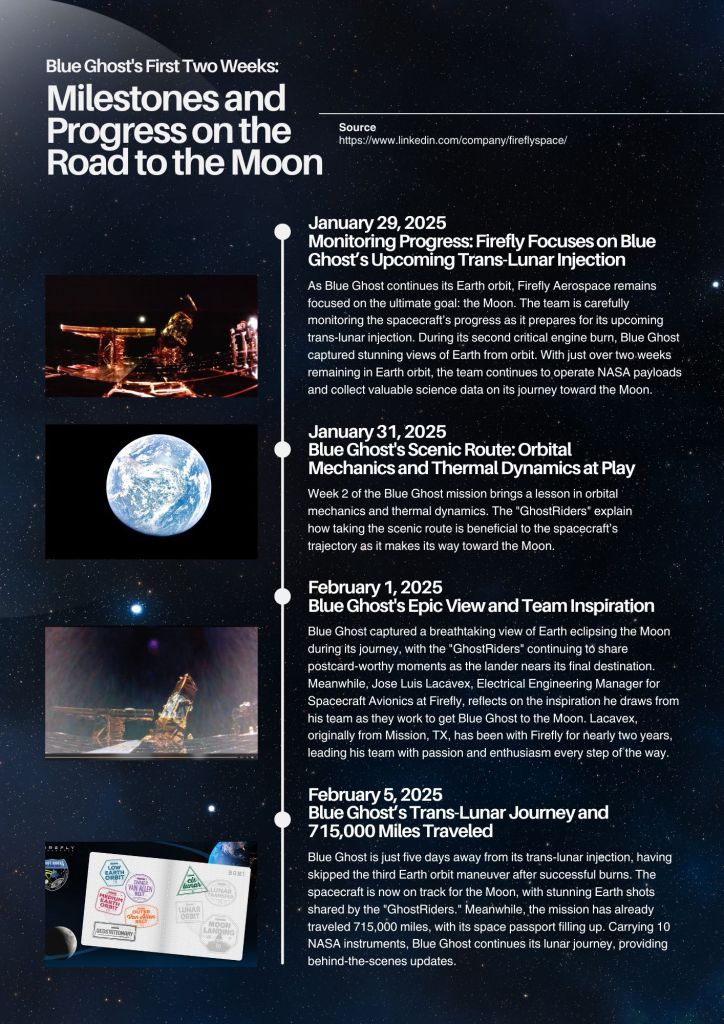
A Private US Spacecraft Headed to the Moon captures a Glorious View of Earth
CAPE CANAVERAL, Fla. (AP) — A private U.S. spacecraft bound for the moon has captured stunning images of Earth one week into its flight. Still circling Earth, Firefly Aerospace’s lunar lander fired its thrusters Thursday to put it on a path to reach the moon in over a month. Dubbed Blue Ghost, the spacecraft beamed back photos and video of the Blue Marble, our planet. The Texas company released the images Friday. It carries experiments for NASA, part of the space agency’s effort to return astronauts to the moon this decade. Blue Ghost is one of two lunar landers launched from Florida by SpaceX on Jan. 15. It’s targeting a moon touchdown on March 2. The other lander is sponsored by the Japanese company ispace and taking an even longer route, with a landing in late May or early June. It’s the first moonshot for Firefly and the second for ispace, which crashed its first lander into the moon in 2023. Tokyo-based ispace’s latest lander, Resilience, is still orbiting Earth and performing all its maneuvers to close in on the moon.
Firefly’s Blue Ghost Mission Nears Historic Lunar Landing with Scientific and Cultural Payloads
Cedar Park, TX – February 26, 2025 – Firefly Aerospace’s Blue Ghost Mission 1 (BGM1) is nearing its highly anticipated lunar landing in Mare Crisium on March 2, having successfully navigated its journey from Earth orbit. Since launching earlier this month, the spacecraft has achieved critical milestones, executed precise maneuvers, and downlinked nearly 19 GB of mission data.
The NASA-funded mission carries ten scientific experiments aimed at advancing lunar research while also making history with cultural payloads that celebrate humanity’s connection to space. Among them is The Mariwai Project, a collection of artworks curated by artist Shiva Lynn Burgos, honoring the indigenous communities of Papua New Guinea’s East Sepik Province. Featuring portraits of the region’s original inhabitants and depictions of ancestral ceremonies, these works mark a historic fusion of art and space exploration, ensuring cultural heritage extends beyond Earth.
Blue Ghost began its lunar transfer phase with a successful trans-lunar injection burn, setting it on course for the Moon. A precise trajectory correction ensured accuracy, eliminating the need for additional mid-course adjustments. Within days, the spacecraft had downlinked 13 GB of data, supporting NASA’s experiments on radiation-tolerant computing and magnetic field measurements in deep space. After entering lunar orbit with a critical insertion burn, Blue Ghost captured its first close-up images of the Moon, offering a glimpse of its targeted landing site. A timelapse video later showcased its dramatic approach, providing a dynamic view of its orbital entry.
As part of its mission objectives, Blue Ghost has been actively conducting scientific operations. A second lunar orbit maneuver transitioned the spacecraft into a lower elliptical orbit, capturing high-resolution imagery of the Moon’s far side. It also successfully acquired and tracked Global Navigation Satellite System (GNSS) signals—an unprecedented feat in lunar orbit. Alongside its scientific mission, Blue Ghost carries The Mariwai Project, bringing indigenous art to the Moon for the first time. The project showcases the cultural expressions of Papua New Guinea’s East Sepik communities, preserving their history, identity, and traditions in a form that will endure for generations. These works reinforce the Moon as both a frontier for scientific discovery and a canvas for human expression.

Final Descent Approaching
In preparation for landing, Blue Ghost recently completed its final orbit maneuver, performing a burn to enter a near-circular low lunar orbit. This critical step sets the stage for its descent orbit insertion on March 2, when the spacecraft will begin its controlled approach toward Mare Crisium. With payloads representing both scientific progress and cultural preservation, Blue Ghost is poised to leave a lasting impact on lunar exploration. Firefly Aerospace remains focused on delivering NASA’s experiments and The Mariwai Project safely to the lunar surface, supporting the Artemis program and paving the way for future commercial and artistic missions to the Moon.

Papua New Guinea Culture Lands Forever on the Moon
Mission Accomplished: PNG on the Moon
In a groundbreaking moment for Papua New Guinea, the nation’s cultural heritage has made its mark on the Moon as part of the historic LifeShip lunar mission which successfully landed on the Moon on Sunday 2 March at 18:34 PGT. As SpaceX’s Falcon 9 rocket and the Firefly Aerospace’s Blue Ghost lunar lander lifted off from Kennedy Space Center on January 15, it carried with it profound symbols of Papua New Guinea’s artistic traditions and ancestral wisdom. The LifeShip Pyramid on the Moon is a small, golden monument designed to celebrate, preserve, and continue the life and culture from Earth. The Pyramid contains a seed bank and a digital repository of life on earth. This interplanetary time capsule includes digital sounds, films and photographs from Papua New Guinea with a special focus on the artistic traditions of the Kwoma people of East Sepik Province. These records from The Mariwai Project are included in the mission which has been fully funded by LifeShip and NASA. The LifeShip “Pyramid on the Moon” mission is a unique opportunity for Papua New Guinea to preserve its diverse cultures on a cosmic stage.
Papua New Guinea’s Cultural Legacy Lands on the Moon with Blue Ghost Mission 1
March 2, 2025 – In a historic milestone, Papua New Guinea’s artistic and cultural heritage has touched down on the Moon as part of Firefly Aerospace’s Blue Ghost Mission 1. The lander, which carried scientific instruments and cultural archives, successfully reached the Moon’s Mare Crisium, marking an unprecedented moment for PNG’s presence in space. Among the cultural treasures onboard are digital recordings of traditional Kwoma ceremonies and artistic processes, portraits of Sepik River peoples, and cultural knowledge and stories collected through ongoing research. These materials by artist Shiva Lynn Burgos and The Mariwai Project (TMP) now form part of an interplanetary time capsule, ensuring that these records of the rich traditions of PNG endure for generations to come.
“This moment is more than a technological achievement—it is a testament to the resilience, creativity, and cultural depth of the Papua New Guinea people,” said Burgos.
“For the first time, PNG’s artistic legacy has found a place beyond Earth, preserving centuries of oral traditions, visual storytelling, and traditional knowledge systems on the lunar surface.” The LifeShip Pyramid, a small golden monument included in the payload, represents a broader mission to preserve humanity’s cultural diversity in space. PNG’s contributions, centered on the artistic and ceremonial traditions of the Sepik region, now join this ambitious effort to safeguard human heritage beyond Earth. Firefly Aerospace’s successful landing is a milestone in commercial lunar exploration, marking the first U.S. lunar surface mission in over 50 years. While NASA’s scientific instruments will collect data from the lunar surface, PNG’s cultural archive stands as a powerful reminder that space is not just a frontier for science but also a canvas for human expression and history. As the world looks to the Moon for new scientific discoveries, Papua New Guinea’s cultural presence on its surface reinforces the universal power of art and storytelling—an enduring connection between Earth and the stars.
Follow the Mission
- https://apnews.com/article/moon-landings-nasa-japan-spacex-8b6e29d17c463e8760c9baa2a75db54a
- https://apnews.com/article/moon-firefly-lunar-lander-blue-ghost-ccdad693e7b94e2962f89b8a23fa6c5d
Uplift Aerospace x Blue Origin x The Mariwai Project
In 2021, The Mariwai Project collaborated with Uplift Aerospace, a pioneering space technology company as part of Uplift’s “Art x Space” program. Shiva Lynn Burgos of The Mariwai Project was selected to create a “Pangal Painting” on a drogue shute panel of Blue Origin’s sub-orbital rocket.
She chose to represent a comet, the traditional Mowai figure depicting the afterlife of human and animal spirits within the cosmos.

The Mariwai Project’s involvement represents another way in which it directs resources to important and cutting-edge causes while expanding the boundaries of what is possible through the integration of art, technology, and space exploration.
This collaboration is another example of Mariwai Project’s commitment to fostering cross-cultural exchange, technological innovation, and positive social impact.
Uplift offers comprehensive manufacturing and logistics services to help brands and creators build innovative products in space. The company has established a network of strategic partnerships and agreements with prominent organizations, including NASA, the Smithsonian Institution, the University of Arizona, the University of Wisconsin, the University of Central Florida, Blue Origin, and the Orbital Reef Space Station. These collaborations allow Uplift to leverage cutting-edge space-based resources and expertise to support the development and production of groundbreaking products for its clients, providing them with end-to-end solutions to bring their space-based innovations to life.
 The Mariwai Project